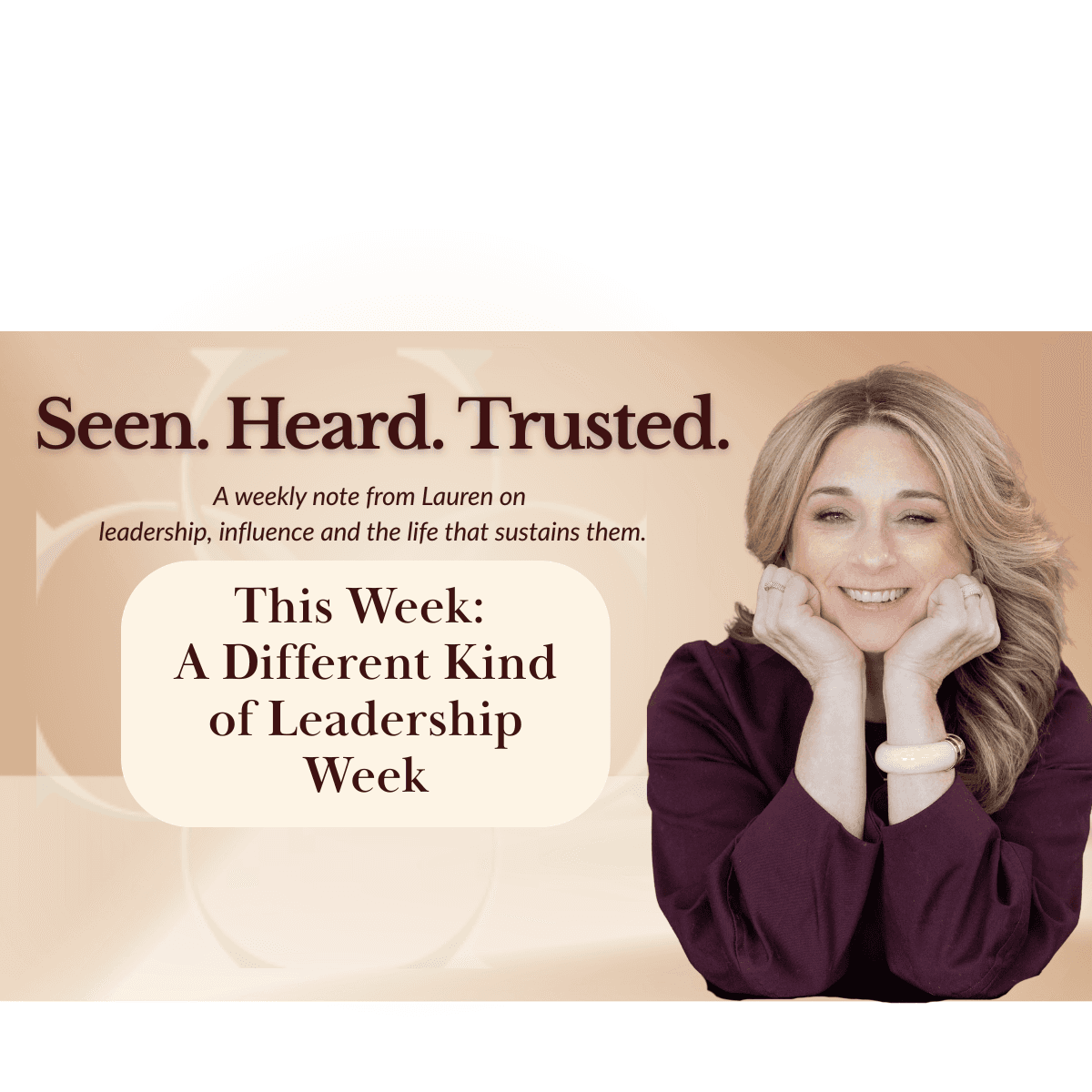
This week looked a little different for me.
I’m recovering from surgery—which, thankfully, won’t keep me paused for long—but has required me to slow down in a way I’m not particularly good at. I still want to be engaged, connected, thinking. But for now, my energy has limits—and I am learning to respect them.
In some ways, it’s a strange week—and an unexpected way to start this newsletter. But also fitting.
Because it reflects something I believe—and advise—often:
Leadership isn’t about operating at full speed all the time. It’s about knowing when to slow down and prioritize—signaling when it’s appropriate to pause and adjust.
This week is important for my health. It’s also created space to go a bit deeper on things I don’t always make time for—thinking, noticing, and reflecting on my work, my business, and the broader environment I’m operating in.
There’s a difference between being busy and being productive. And an even more meaningful difference between being productive and being intentional. I’m not the first to reflect on that distinction—but I see it play out often in leadership communication.
We talk a lot about performance, visibility, and momentum. But far less about energy—what fuels it, what drains it, and how quickly things can shift when it’s not there.
And yet, energy is constantly being communicated through tone, presence, pacing, and priorities. It shapes how messages land, how decisions are interpreted, and how leadership is received.
This week, I’ve been paying closer attention to that—in myself, and in the leaders I work with.
Because the truth is:
How a leader manages their energy shapes how their leadership is interpreted—and ultimately, experienced.
Worth Your Time
These days, the AI conversation is constant—but this week, I’ve noticed a shift—from the technology itself to what it means for people.
This week, a few pieces stood out:
Anthropic’s Peter McCrory on AI’s accelerating impact on white-collar work. Automation is moving into roles many assumed were insulated. It’s not theoretical anymore—it’s already reshaping expectations. No matter your profession, AI can feel uncertain—but it also presents real opportunity.
As a writer at my core, I’ve thought a lot about this. A few years ago, I found myself wondering if my “gift” would become obsolete. There’s now a name for that feeling—FOBO, or fear of becoming obsolete. This perspective is a helpful lens on what many employees are experiencing, even if they’re not saying it directly.
And then this idea, coming out of recent CEO conversations reported through one of my go-to daily newsletters, Fortune's CEO Daily:
→ We may need a “Manhattan Project” for labor to manage the pace of AI transformation.
That’s not a small statement.
What I’m hearing more consistently is this tension:
real excitement about what AI can unlock
real concern about what gets disrupted along the way
What this means for leaders:
This isn’t just a technology shift. It’s a confidence and communication moment.
People are asking:
Where do I fit?
What happens to my role?
What should I be learning now?
Leaders don’t need perfect answers—but they do need to:
acknowledge the tension
communicate direction clearly
create a sense of forward movement
Because when uncertainty isn’t addressed, people interpret the silence.
The Leadership Edge
In moments like this—whether driven by change, pressure, or uncertainty—leaders often focus on explaining what’s happening.
But one of the most effective communication shifts is this:
Don’t just communicate what’s changing. Be explicit about what is not.
What remains steady. What people can still rely on. What isn’t up for debate.
It doesn’t eliminate uncertainty. But it creates stability.
And that stability shapes how everything else is heard.
Beyond the Room
Given the slower pace this week, I’ve been paying more attention to what actually supports energy—and what doesn’t.
A few things stood out:
Simple, practical reminders that small habits can shift how you feel (and succeed) more quickly than we think. Ashley Davis brings this to life in The Power Pivot. I’m so excited for Ashley as she launches her book. She was part of our 20-something group when we worked for then–Pennsylvania Governor Tom Ridge. It’s great to see her rise.
A renewed focus on sleep—because everything feels harder when you’re tired. This article makes me want to try the trending “Sleepy Girl” mocktail and reach for almonds at night.
A perspective on work-life balance that reinforces that boundaries don’t have to be complex to be effective—like the Netflix cofounder who stopped work at 5 p.m. every Tuesday for 30 years.
As part of my recovery process, my youngest son suggested we watch Amazon Prime’s Soul on Fire. What a powerful reminder of resilience and perspective when things don’t go according to plan. Based on the real-life story of John O’Leary, the credits hadn’t even come to a close before I ordered his book, On Fire: The 7 Choices to Ignite a Radically Inspired Life. I can’t wait to dive in.
And in a completely different category—we’ve been in the middle of refreshing our bedroom. Moving from stark navy blues and whites to more neutral, grounded tones with texture and warmth. It’s still a work in progress, but it already feels different—and a great place to rest in my moment of pause.
It’s a small thing—but environments matter. More than we often give them credit for.
(Note: All links are shared as a courtesy—there are no partnerships or financial benefits tied to any recommendations.)
What’s Ahead
I’m continuing to work with a small number of leaders stepping into new or expanded roles—particularly those navigating visibility, complexity, and the need to establish credibility quickly.
If that’s something you’re thinking about, you’re always welcome to reach out via DM or schedule a conversation.
Closing
This week, I’m paying closer attention to how energy shapes how I show up—and how others experience it.
Because in the end, leadership isn’t just what we say or do.
It’s how we’re seen, heard, and trusted.